Thursday, March 2, 2017

"Your work with children in nature is sacred."

Wow, it's been a long time since I've written a blog post. A lot has changed in the two and a half years since my last post. My commitment to working with children in nature has not. If anything, the last two years have given me more experience, a broader perspective, and a deeper appreciation for the work of the early childhood teacher with nature as the classroom.


I work for Dodge Nature Preschool, in West Saint Paul, MN. The preschool is located on the grounds of Dodge Nature Center, which is celebrating its 50th anniversary this year. We recently hosted an evening with Richard Louv at the Fitzgerald Theater in St. Paul, during which a great conversation unfolded about the value of nature in the lives of children. If you are not familiar with Louv's work, he coined the phrase "nature deficit disorder" in his book Last Child in the Woods. Since its publication in 2008, we've seen a movement driven by educators, researchers and parents to bring the importance of nature to the table, to advocate for nature in schools, in the workplace, in healthcare, housing, and more.


If you're reading this blog, chances are you already understand the value of nature for healthy individuals and communities. Here are some of the things I took away from the conversation that evening, some ideas I'm still pondering and trying to figure out how to expand on in my own work.

  • Regarding the importance of getting children outside early in life... Truly, parents often end up rediscovering the wonder of the natural world right alongside their children. It happened for me. Shortly after my daughter was born, I put my teaching career on hold to be home with her. The days can feel incredibly long when you're a stay at home parent. Getting outside was crucial for my own mental health as well as for her development. The fresh air, the change of scenery, something about just walking around the block to clear our minds and lift our spirits was the antidote to many tough moments. Even better, the more we were outside the more we wanted to be outside. Everything was new and wondrous to my toddler - every rock held the potential of exciting new discoveries beneath it. Every new sensory experience was magical. It was those tough but precious years that drove me back to school to earn a Master's degree in Environmental Education.
  • "Nature teaches compassion, hope, and acceptance." One spring my daughter found a robin's egg on the ground. Whole, beautiful, blue, delicate. She was sure that if she brought it home, placed it under a warm blanket, and watched over it that it would eventually hatch. Of course it didn't and that was a hard lesson for her. But in the process of trying to hatch the egg, she learned about life, death, empathy for other beings, care for another, to hope, to try, and to accept that sometimes there were things she could not explain or change. 
  • Everything is connected. We are not alone. We need other species. Consider this study from the United Kingdom. Researchers found that city parks with higher biodiversity actually have a larger positive impact on mental health than parks where there is less diversity of species. Kind of makes sense. Being surrounded by more forms of life means a healthier ecosystem, of which humans are a part. We know that monocultures are not a good thing. The emerald ash borer epidemic in Saint Paul is a perfect example. Plant a large portion of your city boulevards with the same tree and when an insect specific to that tree starts to kill them, you've got no trees left.
  • Cities can become engines of biodiversity. Think of rooftop gardens, inner city parks, pollinator gardens, and schoolyard gardens. When you plant a garden or protect green space in a city you create habitat for species other than human. And having those species around is important not only because they have a right to exist, but also for human well-being.
  • In terms of nature being beneficial to child development, here's an interesting, and alarming, finding: Spatial sense atrophies in children who don't spend time outside. Do we want to raise children who are so dependent on technology that they can't navigate in the real world without it? Check out The Geography of Childhood: Why Children Need Wild Places, by Gary Paul Nathan and Stephen Trimble.
  • "Your work with children is sacred" (Richard Louv, 2/9/17). It isn't often that we speak of the sacred in public discourse. We seem hesitant to talk about spirituality because it gets mucked up by religion. But this isn't about a particular faith. Yes, the word sacred is used in reference to worship or religion, but it is also defined as "something highly valued and important." So what nurtures the spirit? What can we do in our work with young children that is deserving of the label sacred? To me as a teacher and parent, it is taking children outside and letting them lead, watching them discover, explore, and observe, helping them test boundaries and take risks, encouraging them to ask questions and make connections. That truly is sacred work. And it is an honor to be part of it.


Tuesday, August 5, 2014

"Did you know there's such a thing as Nature Deprivation Syndrome?"

"Did you know there's such a thing as Nature Deprivation Syndrome?" That's how our conversation began. I was working in one of my boulevard gardens today and a man approached me with a smile and compliments about my garden. He asked me if I knew about this syndrome (It's actually called nature deficit disorder, and is not a medical term, but rather one coined in Richard Louv's book, Last Child in the Woods). He went on to tell me how city kids, in particular, suffer because they don't get to experience things like this - he pointed at the sunflowers, coneflowers, and prairie sage, among other things, growing nearby. We talked a little bit about children and nature, as I explained that I am a preschool teacher at an area nature center. His face lit up and he said, "So you get them when they're really young, and you get to take them outside?" Yes. Exactly.

Boulevard gardens

We know that one of the key factors for adults who love and protect the natural world is having had positive experiences in nature as children. So getting children outside when they are very young and giving them access and freedom to explore and enjoy nature - plants, insects and other animals, dirt, rocks, and elements of weather - is crucial.

Front yard bird feeder

Now what about those city kids? Nature is everywhere, even in the city. One way I make nature available to children in my city, to people of every age really, is through my gardens. I have planted nearly every square inch of our tiny city lot. Front yard, back yard, boulevards, and alley. There are gardens in the ground, in planters, pots, bags, tires, boxes, plants climbing walls and porches, and plants in raised beds. I grow edibles, native perennials, annuals, trees and shrubs. My daughter has her own raised bed in our front yard. Just this year we took out our last remaining bit of turf grass and replaced it with native grasses and wildflowers. We provide habitat for butterflies, birds, bees, squirrels, rabbits, voles and mice, the occasional toad, dragonflies, raptors, worms, slugs, and countless other invertebrates and mammals. And because my daughter is outside all the time, and has been nearly her whole life, she knows every hiding place for every animal. She knows, from observing, what they eat, what type of habitat they require, and how (if appropriate) to safely handle them.

Boulevard garden

I've talked to many people who walk past my house and smile when they look at the gardens. I can see the delight when someone watches a butterfly on a milkweed plant or sees a goldfinch eating seeds from the flower of a cup plant. Gardens make people happy. I suspect some of that happiness comes from the sensory nature in gardens - the colors, scents, textures, the beauty in nature. Gardens remind us of the wonder, joy, and diversity in the natural world. But I think gardens also remind us that there are powers greater than ourselves, that while we can plant things and meticulously try to maintain them a certain way, there is a wildness out there that we can't tame. In my opinion, that's a good thing.

Planters filled with kale, amaranth and dill

So yes, I do know about "nature deprivation syndrome." And I am doing my best to combat it in my little corner of the world. One garden at a time.


Raised bed on boulevard,
planted with beans and squash
Anything can become a planter! These hold sunflowers,
okra, and cosmos. In the alley garden.

Friday, August 1, 2014

"Frogs Are My Life!"

This morning I had the privilege of taking a small group of preschool-aged children for a nature hike. They were excited to show me all of their favorite places on the grounds of the nature center. We started out at a brisk pace, that energy and excitement barely contained. We had a destination in mind, but along the way there were SO many things to stop and examine.

Children are great collectors. We often find sticks, rocks, feathers, pinecones, and other random objects in pockets, bags, and the washing machine. They love to pick things up, carry them, show them to other people, and tuck them safely away in a pocket. On our hike this morning, the children showed me black cap raspberries, burdock, feathers, snails, slugs, and toads.

The toads were especially exciting. In a grassy path, lined with jewelweed and burdock on either side, we found dozens of small toads jumping in front of our feet. The children were quite adept at spotting and catching the tiny creatures. I have to admit that I get nervous when children catch animals. I am always worried about harm to a living being. It's a fine line to walk - balancing a child's desire to learn, and need to touch, with the well-being of a much smaller creature. They were incredibly gentle with the toads and wanted to take them all the way back to school to show their classmates. After a long discussion about what would be best for the toads, we decided to carry them just a short distance to one of their favorite places in the woods and release them there. They reasoned that the habitat was similar and they would be safer in the woods than back in the classroom. The toads, which they insisted on calling "frogs," fared well. They all made it to Tipi Hill, cradled gently in small palms. As the children opened their cupped hands and the toads jumped back out into the world, one child squealed with delight. She stretched both arms to the sky, looked up into the canopy of trees, and exclaimed, "Frogs are my life!"

Indeed, in that moment "frogs" were at the center of everyone's life. It was a wonderful reminder of the power of nature in the lives of children. And why we can't be afraid to let them touch, explore, question, and seek with limited interference. That morning the children experienced freedom, connectedness with their environment, the care of living creatures, patience, confidence, negotiation, the ethics of removing an animal from its habitat, and the sheer joy of discovery. And we only used two band-aids.

The good news for urban-dwellers is you don't need to be at a nature center or deep in the woods for children to have experiences like these. Let them explore the backyard, the schoolyard, a nearby park, an alley, a lawn, or even a sidewalk crack. They will find living creatures. And who knows, your child might joyfully exclaim, "Ants are my life!"

Some nature books in urban settings:
Hey Little Ant, by Phillip and Hannah Hoose
Ladybug Girl and Bumblebee Boy, by Jacky David
The Curious Garden, by Peter Brown

Thursday, July 24, 2014

Seeing What They See

My daughter is a keen observer of all things living outdoors. She will squat for what seems like hours to watch the activity at an anthill, turn over garden stones to find slugs, perch in a tree waiting to get a picture of a squirrel, set a "chipmunk trap" using a pot and a string, or catch flies with a bucket. She knows how to do these things because she is fascinated by things outside of her control. She watches them, trying to learn how they function and why they behave as they do. I would argue that most young children, given the opportunity and the freedom, would do many of the same things.


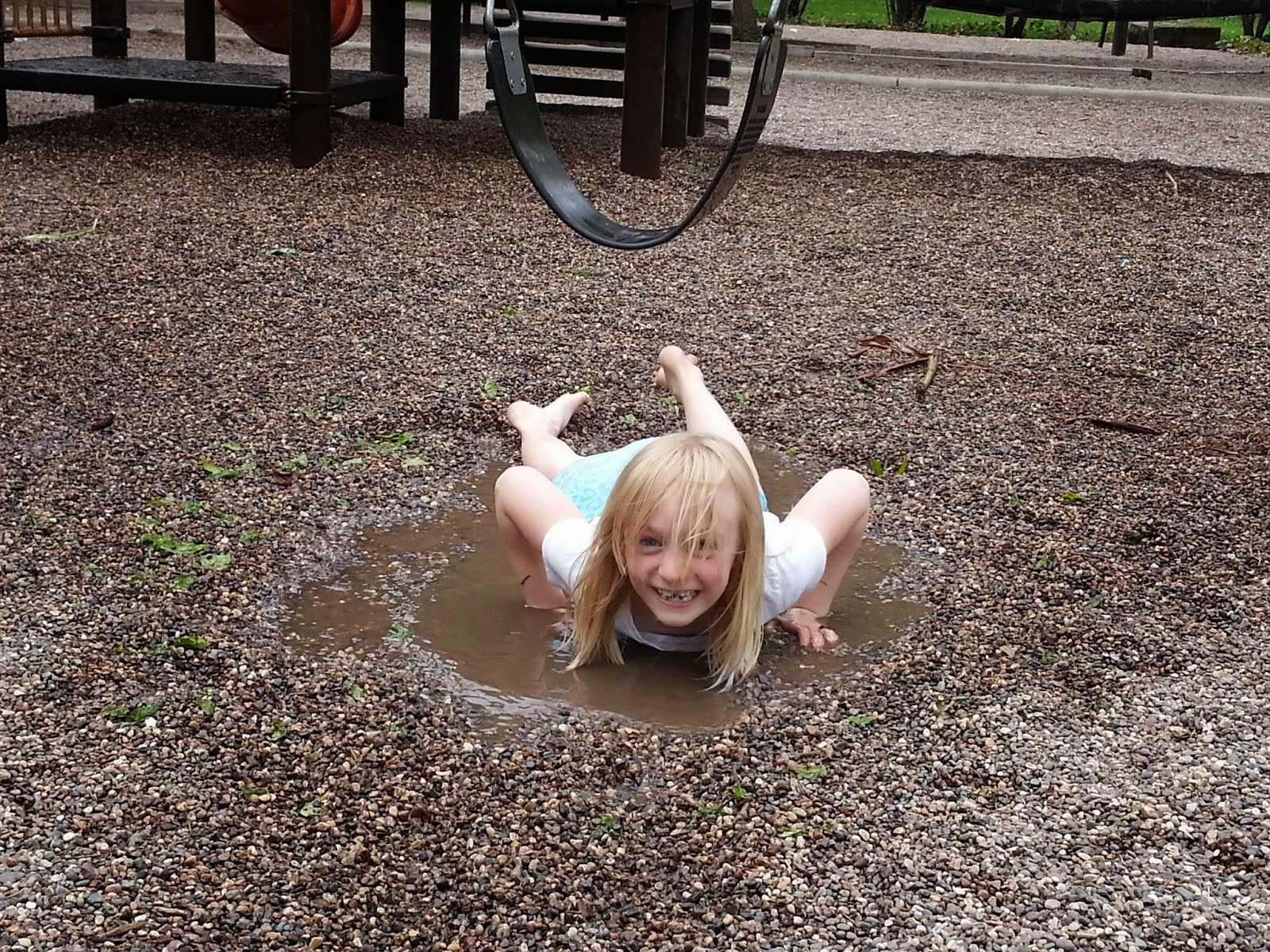
I love watching young children in nature. For me it's like discovering the world all over the again. The surprise, the delight, the joy - they are so palpable. Children explore with all of their senses. How many children can resist jumping in a puddle? Is it because they want to get wet or messy? Perhaps. Maybe they are learning cause and effect. Maybe they want to make something happen. Maybe there's just something irresistible about standing water - the urge to touch it, splash it. Whatever the reason, there is joy in puddles. And in mud too!


Most adults don't want to step in mud. It's dirty. It gets all over your shoes, maybe your pants too. But kids love it. They love the texture, the stickiness, the color, the way it feels and sounds and smells (I actually love the way mud smells too). Mud can be a great medium for creating. Mud can be used for building castles, cakes, sculptures, bowls. The consistency can be made thinner with water and mud can be used as paint on a sidewalk canvas.


The next time you are out in nature with a child, try to see the world as she sees it. Squat or sit down so you are closer to the ground. Try to engage your senses more. Pay attention to what you see, hear, smell, touch, and (if appropriate) taste. Follow the child's lead. You may be surprised at what you notice, what you learn, and what you wonder about. You might find yourself energized. And not so worried about those muddy shoes.


Literature Links
Some of my favorite mud/dirt/water picture books for children:


Mud, by Mary Lyn Ray
Red Rubber Boot Day, by Mary Lyn Ray
Wonderful Worms, by Linda Glaser
Wiggling Worms at Work, by Wendy Pfeffer
A Handful of Dirt, by Raymond Bial
One Small Square (series), by Donald Silver
Mudpies, by Claudia Little


Wednesday, July 23, 2014

What's in a Name?

I've been thinking a lot lately about how we come to know places in nature. Really know them. Know them in a way that makes them dear to our hearts. Know them in a way that makes us want to protect and care for them. Does a place become special to us though repeated visits and close observations? From the memory of something important happening in a place? From the way our senses can recall that place? From knowing it well enough to name it? Perhaps all of those things.

When I was a child we spent a lot of time on the north shore of Lake Superior. My parents owned a cabin outside Grand Marais. I fell in love with astronomy on the shores of the big lake, under a vast starry sky, away from the city lights. It was absolutely magical. I looked up and wondered about those stars and planets, marveled at the size, the numbers, the distance, hoped every time to see that blanket of light wavering in the sky - the northern lights. I had so many questions. What is a shooting star and if I wish on it, will it come true? Which ones are stars and which are planets? Which are satellites and how did they get there? The stars that are light years away sent their light hurtling out into space long ago. Are they still there or did they die out before their light reached my eyes? If there are so many stars out there, and our sun is a star, how can there NOT be other life out there somewhere? I felt so small, so insignificant in this grand astronomical picture, but so alive and full of wonder and the desire to know more.

I borrowed or bought and read every book and magazine I could find about astronomy. I got a telescope and set it up in Grand Marais and on the deck back home. I begged my parents to take me to the Kennedy Space Center when we were in Florida visiting my grandparents. I skipped school (with permission) to meet an astronaut at a book signing. I studied constellations. I wrote journal entries and poems and research papers. My love of the night sky began on the rocky shores of that big lake.

There are many, many things that connect me to the North Shore: the pine, spruce, birch, and aspen trees along Highway 61, the goldenrod-colored lichen on boulders, the memory of picking wild blueberries in the woods, spotting deer and moose and the occasional wolf, noisy gulls, a solitary loon on the lake, family stories around a campfire, the sound of our footsteps on a damp trail through the woods, the constant draw to the lake's edges, and that incredible night sky.

What does all of this have to do with urban nature? It has to do with a child spending enough time outdoors to really come to know a place and develop a special bond. It doesn't have to be the North Shore. It could be at the base of a favorite boulevard tree. It could be an alley where a child discovers raspberry bushes or bunnies. It could be a sidewalk crack where ants are constantly coming and going and doing mysterious things. It could be a small garden visited by pollinators. It could be a backyard bird feeder. The key here, I think, is for a child to be able to have repeated visits, unstructured time, be in a place that feels safe and happy, and for the child to take the lead (maybe we can all try to be "hummingbird parents" rather than "helicopter parents").

When I think about why I, as a parent and a preschool nature teacher, care so much about the natural world, I think back to my early experiences in nature. In fact, many environmental stewards can pinpoint early experiences as a key factor in their love and concern for the earth. So if we want to raise children who take care of the natural world, we can start by letting them get to know it.

Last spring at my preschool, another teacher documented some of the children's conversations at one of their favorite places (children's names have been changed):

Hank: This is the children's forest.
Teacher: The children's forest? Brady: Yeah, the children's secret maze forest. Gregory: It's the children's secret hideout maze forest. Over there is the Wild forest. The really wild forest. Hank: That's a really long name.

Naming something is powerful. What's in a name? In this case the children were taking ownership and telling us what is most important to them about this place, what they love about it. I'd like to think their experiences there, playing, exploring, discovering, and just being, helped connect them to nature in ways that are lasting.

Before I go, here's some advocacy from a former child of the North Shore (yours truly) hoping to keep the skies dark for future young astronomers. Photographer Bryan Hansel puts out this plea with a gorgeous image.


Wednesday, April 23, 2014

Earth Day 2014

Someone asked me how I celebrated Earth Day this year. I try to think of every day as being a day to care for and celebrate the earth. Teaching this to young children is easier than you might think. It all begins with relationships.

Good teaching, in any setting, stems from a foundation of solid relationships. As teachers we must connect with our students. Know them. Consider their needs in the moment. Find something special about them and acknowledge it. I'm not talking about curriculum and standards and test scores as a measure of good teaching or what is best for all children. I'm talking about something much more personal and in my opinion much more important. To me, good teaching always begins with an environment where kids feel safe, relaxed, and valued for who they are. Honoring children in a classroom, in the outdoors, on the playground, in your back yard, wherever you might be, begins with the teacher's relationships with students and their relationships with each other.

So on Earth Day this year I was teaching a preschool class at a local nature center. This is my dream job. It allows me to combine my love for teaching with my love of the natural world. I get to help young children develop their own relationships with the natural world at a crucial time in their development. I get to be with them as they experience the wonder and joy of poking around in the mud or climbing logs or looking at animal tracks. I get to sit next to them on the ground, look up into the trees, find the cardinal singing his little heart out, and marvel at the beauty all around.

These kinds of experiences can happen most anywhere. The nature center where I work is nestled in a residential neighborhood, not far from highways and big-box stores. While it feels like we are hundreds of miles from "the city," the sounds of airplanes and car traffic tell us otherwise. Nature is everywhere.

Last week I had lunch with teachers who had come to a learning conference at our preschool. One was lamenting the fact that her urban kids are afraid to be outside. She asked how to help them not be afraid of bugs and dirt and things they aren't familiar with. My best advice to her, to anyone who finds herself in nature with children, is to be present with them. Sit on the ground. Be level with them. Be close. Try to experience those things right along with them. Try to be that calm and nurturing presence. Children know when you are uneasy. They also know when you are excited, when you are happy to share your time with them, when you enjoy being in the natural world with them. Your enthusiasm will help to ease their fears and just might spark their own sense of wonder.

I spent my Earth Day this year with children, digging in last year's garden beds, holding worms, finding animal tracks and comparing them to our own, lying down in the leaves and looking up at puffy clouds, feeling the warm sunshine on my face and watching children do the same. I stepped in the mud, I caught children as they jumped from boulders and logs, I watched ants, built stick forts, laughed, and gave thanks to the earth for being the best classroom there is. And when I got home, I did a load of laundry.


Saturday, September 21, 2013

Sounds of Summer

Cicadas are pretty active these days, which seems late in the year for Minnesota. While talking with a friend about this, she said, "Cicadas are the sound of summer." A few years ago I wrote a poem about my childhood summers that began with those exact words. Late summer in the city always meant scabby knees and stubbed toes, banana-seat bikes with colorful straws on the spokes, pigtails turned golden from sun, lemonade stands, hopscotch boards drawn on hot sidewalks, and sitting on gnarled tree roots, gazing up into a leafy canopy. Hearing a cicada today brings back all of those images for me. Sound is a powerful trigger.


I wonder what a cicada's song will mean for my daughter, years from now. Will she think about the box of cicada exoskeletons (a creepy, but cool, collection) she's saved over the years? Will she think about the time she got so mad and ran away from home (but let me accompany her), to a grassy boulevard a couple of blocks away where we sat in the shade of trees and listened to cicadas? Will she think about the adult cicada she "rescued" from a sidewalk, only to find that its abdomen was missing so it would probably die soon anyway? Or will her summer memories, triggered by cicada songs, have nothing to do with the insect at all?


I hope she remembers how much time I was able to spend with her in the summer, how we ambled through alleys, scootered all over the neighborhood, biked together, planted gardens, raised monarchs and praying mantises, and picked and ate raspberries and ground cherries. I hope she will still love the crab apple tree in our front yard, the flagstones she overturned in her search for bugs and worms, and the swing hanging from the white pine. Perhaps she will think of the sparrow she rescued from the dog, the bunnies she rescued from window wells, or the secret space between the garages that she called "Ponyville."


How can we help children make those memories and connect to the natural world in meaningful and joyful ways? Does it matter? The two greatest indicators of responsible environmental behaviors in adults are spending time outdoors as a child and having a parent or other role model who values the natural world (Louise Chawla). It doesn't have to be complicated. We don't have to go out of the city or have a degree in environmental education to cultivate a child's love of nature. It's already there. We just have to slow down, notice what kids are noticing, and give them a little time and space to explore.

What will your children remember of summer?


A few interesting cicada facts:

  • Here in Minnesota, we have cicadas that are called dog day (annual) cicadas. They occur every year. The 13- or 17-year periodical cicadas do not occur in Minnesota.
  • Only the males make the humming/buzzing sound. They do this to attract females.
  • Cicada nymphs (young cicadas) feed on tree roots beneath the ground.
  • Adult cicadas only live a few weeks - just long enough to mate and lay eggs.
  • When you find a cicada with part of its body (the abdomen) missing, this is most likely due to a fungus called Massospora.